Invocation of the Muses
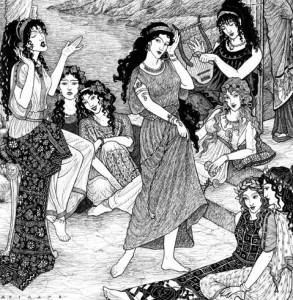
Thalia Took’s Sketch of 9 Greek Muses
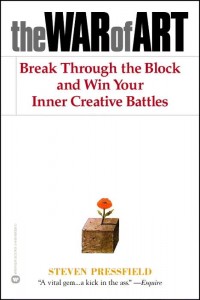
One of Steven Pressfield’s main topics of focus in The War of Art is the fight against what he calls Resistance — the unrelenting struggle a writer faces to NOT write. Every day a writer has to push forward and make the writing happen. You just can’t wait for inspiration, at least not if you’re going to write professionally.
I’ve found that The War of Art is one of the most useful writing books I’ve ever read because of its description of and advice about waging the battle against Resistance (note the capital R — you must respect the enemy). To help me do battle, one of my tactics is to recognize that when you sit down to write you’re entering a different kind of mental state. I tell writing students that just as a professional athlete would not simply arrive at the track field and start sprinting, a writer will be poorly served to jump into the seat and immediately start typing.
It’s my thought that you have to acknowledge that change, that transition from one mental state (where you’re worrying about groceries and laundry or that news article) to another where the story is all, in order to do good work.
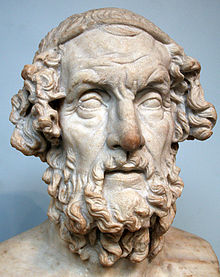
On the first page of The War of Art, Pressfield describes what he does each day to prepare to write so that he can be in the proper frame. Amongst several other personal rituals, Pressfield says a prayer. His is the Invocation of the Muse from Homer’s Odyssey, translated by T.E. Lawrence (that’s Lawrence of Arabia, incidentally).
I’ve never been much of a praying man myself, but I liked the sound of this, so I looked up the prayer, which I had read as a school boy and probably blipped over:
 O Divine Poesy
Goddess-daughter of Zeus,
Sustain for me
This song of the various-minded man,
Who after he had plundered
The innermost citadel of hallowed Troy
Was made to stray grievously
About the coasts of men,
The sport of their customs good or bad,
While his heart
Through all the seafaring
Ached in an agony to redeem himself
And bring his company safe home.
Vain hope – for them!
For his fellows he strove in vain,
Their own witlessness cast them away;
The fools,
To destroy for meat
The oxen of the most exalted sun!
Wherefore the sun-god blotted out
The day of their return.
Make the tale live for us
In all its many bearings,
O Muse.
 That’s glorious. I love it. Even though I do not think of the Muses as deities but as personifications of a state of mind that an artist must tap, I thought acknowledging the Muses with a sort of prayer would be an excellent acknowledgment of the transitional moment.
But I found a problem with the above prayer. Not with its language, but with its highly specific focus. When I tried to speak it, I was brought immediately to mind of someone else’s story. Odysseus, naturally. I wanted a prayer to the Muses that was not necessarily aimed at the telling of one of Homer’s great works.
So I penned one myself. It does not approach the glory of the prayer created by one of the world’s greatest writers, but it is a prayer with words that speak for me.
The odd thing is that once I say the prayer, I feel like the matters I’m about to craft are more serious, and so I am far less tempted to check my e-mail or FB or Tweet or what have you. I’m all about the work.
I say again that I do not believe in Muses watching over us. But I do believe we must acknowledge and try to understand the creative spirit within us if we are to work with it to bring out our best work.
So, with that preamble, here’s my prayer to the Muses:
Invocation to the Muses
(Howard Andrew Jones)
Muses, I praise thee.
Grant me the vision to craft words of power that sear into the mind’s eye.
Let my ears hear words that are true and pure.
Let my inspiration be a mighty steed that carries me forward.
I pledge to you that I shall fight Resistance and strive to bring glory to the tales you would have me tell.
Let the work begin.
55 Comments